
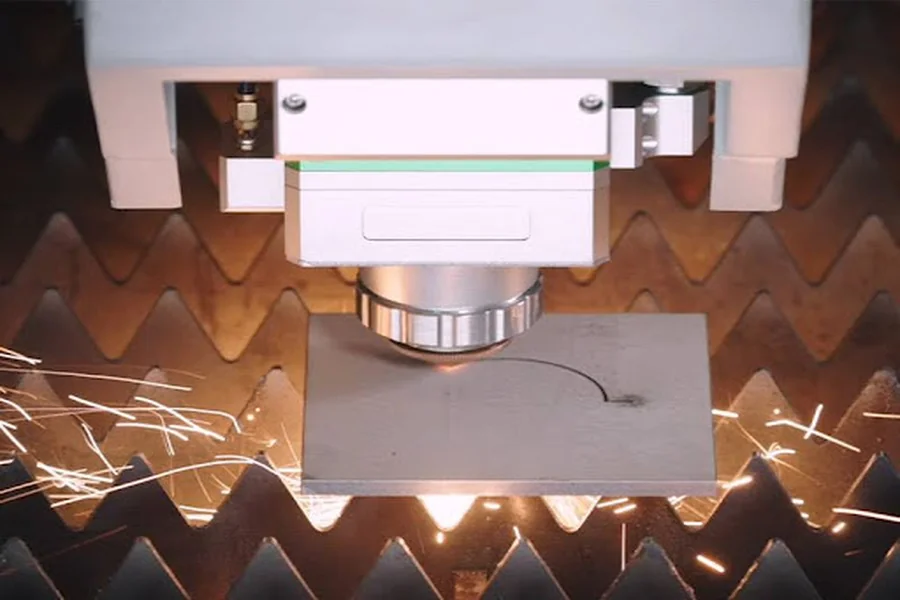
In the medical industry, laser marking is far more than simply adding a serial number or logo to a device. It is a critical part of traceability, patient safety, and regulatory compliance. A UDI (Unique Device Identification) code must remain readable after repeated sterilization cycles, years of surgical use, and in some cases, decades inside the human body.
Across Canada, the United States, and international healthcare markets, regulatory expectations for medical device traceability continue to increase. Manufacturers must ensure markings are permanent, biocompatible, and resistant to the full lifecycle conditions medical devices experience.
This guide explains how laser marking for medical devices works in real-world production, which laser technologies are best suited for medical materials, and the best practices manufacturers use to meet FDA, Health Canada, MDR, and ISO 13485 requirements.
Why Laser Marking Is Essential for Medical Devices
Traditional identification methods like adhesive labels, ink printing, or surface-applied markings simply do not hold up in medical environments.
Autoclave sterilization, chemical sterilization, gamma radiation, and constant handling quickly degrade conventional markings. In some cases, labels or coatings can even create contamination risks.
Laser marking solves these challenges by producing:
- Permanent identification marks
- High-precision UDI and Data Matrix codes
- Sterilization-resistant markings
- No inks, chemicals, or adhesives
- Excellent compatibility with stainless steel, titanium, and medical polymers
- Reliable traceability throughout the product lifecycle
For many reusable surgical instruments and implantable devices, direct part marking is no longer optional — it is a regulatory requirement.
FDA, Health Canada, MDR, and ISO 13485 Requirements
FDA UDI Requirements
Medical devices sold in the United States must comply with the FDA’s Unique Device Identification (UDI) system.
UDI codes include:
- Device Identifier (DI)
- Production Identifier (PI)
- Lot or batch number
- Serial number
- Manufacturing date
- Expiration date
These marks must remain:
- Permanent
- Human-readable
- Machine-readable
Health Canada Medical Device Regulations
Health Canada also requires strong traceability standards for medical devices distributed in Canada.
Manufacturers must maintain:
- Device identification records
- Production traceability
- Recall capability
- Product lifecycle documentation
Laser marking plays a major role in meeting these requirements for reusable and implantable devices.
ISO 13485 Process Validation
ISO 13485 requires manufacturers to validate production processes that affect product quality — including marking systems.
An important point: the laser itself is not “FDA approved.” The manufacturer validates the marking process used on their specific materials and products.
Any significant change to:
- laser parameters
- software
- machine configuration
- material supplier
may require revalidation.
The Four Main Laser Marking Processes Used for Medical Devices
Medical laser marking is not a single technique. Different applications require different processes depending on material type, corrosion sensitivity, and sterilization requirements.
1. Laser Annealing
Best For:
- Stainless steel surgical instruments
- Titanium implants
- Corrosion-sensitive surfaces
Laser annealing creates a dark oxide layer beneath the metal surface without removing material.
Advantages include:
- No surface cavities
- No bacteria-trapping texture
- Preserves passivation
- Excellent autoclave resistance
This is the preferred process for many reusable surgical tools and Class II medical devices.
2. Laser Ablation
Commonly Used For:
- Anodized aluminum
- Medical polymers
- PEEK components
- Coated medical devices
Laser ablation removes a thin surface layer to create high-contrast markings.
Applications include:
- Catheter depth markings
- Polymer connectors
- Medical housings
- Coated instrument components
3. Laser Etching
Suitable For:
- Metal housings
- Non-fluid-contact components
- Hard polymers
Laser etching lightly melts the material surface to create a shallow mark.
Benefits include:
- Fast production speed
- Strong visual contrast
- Efficient industrial throughput
However, etched surfaces may not be ideal for certain implantable or fluid-contact applications.
4. Deep Laser Engraving
Best For:
- Orthopedic implants
- High-wear instruments
- Abrasive environments
Deep engraving removes material to create highly durable recessed marks.
This process offers maximum wear resistance but requires careful evaluation for implantable applications due to surface topography considerations.
Which Laser Type Is Best for Medical Device Marking?
Fiber Lasers: The Standard for Medical Metals
1064nm fiber lasers are widely used for marking:
- Stainless steel
- Titanium
- Aluminum
- Cobalt-chrome alloys
Advantages include:
- High-speed marking
- Excellent precision
- Low maintenance
- Consistent repeatability
Fiber lasers are now standard in many Canadian and North American medical manufacturing environments.
MOPA Fiber Lasers: Preferred for Stainless Steel Medical Instruments
MOPA fiber lasers provide precise pulse duration control, enabling true annealing without damaging the stainless steel passivation layer.
This is especially important for:
- Reusable surgical instruments
- Corrosion-critical devices
- FDA Class II and III products
MOPA systems are often preferred for high-end medical manufacturing where sterilization resistance and corrosion protection are critical.
UV Lasers: Ideal for Medical Plastics
UV lasers produce “cold marking” through photochemical reactions rather than heat.
They are commonly used for:
- PEEK implants
- Medical polymers
- Catheters
- Connectors
- Heat-sensitive components
UV marking minimizes thermal damage and preserves delicate material structures.
Best Practices for FDA-Compliant Medical Laser Marking
1. Validate Every Process
Each combination of:
- material
- laser type
- power
- speed
- pulse settings
- surface finish
must be validated before production use.
Even small parameter changes may require process revalidation.
2. Test Sterilization Resistance
Medical markings must survive:
- Autoclave sterilization
- Chemical sterilization
- Ultrasonic cleaning
- Abrasion testing
- Gamma radiation exposure
Long-term durability testing is essential.
3. Verify Data Matrix Readability
UDI Data Matrix codes must remain readable throughout the product lifecycle.
Verification typically includes:
- Contrast analysis
- Module sizing
- Quiet zone validation
- Curved surface readability
- Scanner compatibility
4. Optimize Parameters for Each Material
Different surface finishes react differently to laser energy.
Polished stainless steel, bead-blasted titanium, and satin-finished aluminum all require different settings.
Material testing should always be completed before scaling production.
5. Maintain Full Documentation
Under ISO 13485, manufacturers should document:
- Laser parameters
- Validation records
- Inspection results
- Maintenance logs
- Batch traceability
Comprehensive documentation is essential during audits and inspections.
Common Applications for Medical Laser Marking
Laser marking is widely used for:
- Surgical instruments
- Orthopedic implants
- Bone plates
- Dental components
- Surgical screws
- Catheters
- Medical housings
- Robotic surgical systems
- Implantable devices
OMTech Laser Solutions for Medical Marking
Many manufacturers and contract suppliers use OMTech Canada systems for precision marking on stainless steel and titanium medical components.
Popular systems include:
- Galvo Fiber Lasers (20W–50W)
- MOPA Fiber Lasers for stainless annealing
- High-resolution UDI marking systems
These machines offer:
- High-speed production marking
- Precision Data Matrix engraving
- Autofocus capability
- Repeatable mark quality
- Excellent compatibility with medical alloys
FDA-compliant laser marking has become a critical part of modern medical device manufacturing.
It is not simply about engraving a code onto metal. It is about ensuring:
- patient safety
- long-term traceability
- sterilization resistance
- regulatory compliance
- permanent identification
For Canadian and North American medical manufacturers, selecting the right laser technology is an investment in reliability, compliance, and production quality.
Today, MOPA fiber laser systems remain one of the leading solutions for high-contrast, corrosion-resistant medical marking on stainless steel surgical instruments and implantable devices.